viernes, 30 de mayo de 2014

Heels and Soccer


     I have decided to create a short version of how I would explain the world, or rather a girl’s world, with soccer. This is a variation of Franklin Foer’s work How Soccer Explains the World: An Unlikely Theory of Globalization.

     To the point where I have read, I have found only one thing Franklin Foer and I have in common; we both “suck at soccer” (1). Despite the lack of skills in the sport, we both decided to explain different matters of the world with it. Him, because of the “love for soccer that developed into something mad” (2). And me, because well, I had to write a blog-post.

     When walking the halls of Centro Comercial Andino, the “power of mega-brands like the clubs Manchester United and Real Madrid, backed by Nike and Adidas” (4) attract desperate teenage girls who are in the middle of a search for a gift for their boyfriends. It doesn’t matter if it’s his birthday, their anniversary, or a reconciliation they are celebrating, giving a soccer team jersey to a boy will always be the easiest way out. He will like any jersey, if it’s a team or player he likes.

     If you are a girl, you will eventually have to understand that boys will sometimes like famous soccer players such as Cristiano Ronaldo or Iker Casillas, more than they will like you. You will have to get used to texting your boyfriend while you look at his display picture which will probably be one of Ronaldo’s abs, or if they recently won the Champions League, a picture of hero Sergio Ramos very likely screaming his lungs out. I know it’s hard, scrolling down Instagram’s newsfeed just to find out your sweetheart has liked more soccer players’ pictures than your own. 

    And still, us girls continue to pretend we care about the 22 men in a soccer field running after a ball. 

   Most of the times we will find no explanation for things that happen related to soccer. I, for  instance, will try to find some in Franklin Foer's book. 

     As for now, we girls have to understand that just like Foer says, “soccer has been brought to the far corners of the world and into our lives” (6).

lunes, 26 de mayo de 2014

miércoles, 19 de marzo de 2014

Commas are not in Command


       I think we live in a world where capitals and extra-letters are more noticed than commas. Many people text more in a normal day than what they actually speak. Even more people prefer to express themselves and face tough situations through social networks such as Whatsapp, Twitter, and Facebook. Whether it’s anger, sadness, happiness or any other emotion, we tend to write (or in this case text) in a certain way. When we get the alert on their phones that someone just texted us, we immediately scan the screen. If the text is written all in capital letters, then something must be wrong. If the person added two extra letters to the end of a word, then nothing is wrong but if they added more than two, they’re intense, very angry, or maybe drunk. You make all kinds of assumptions when it comes to these kinds of factors that for you, can change the entire meaning of a text. But do we even notice commas? When are we using these cute little things?

     The article “Will We Use Commas in theFuture” by Matthew J.X Malady argues whether or not commas are needed. As to what I said before about commas in texts, he says that “commas don’t thrive in those environs” and that “it’s being purged.” Also, Malady says that commas are “in some ways like ketchup and mustard.” I agree that we’d all survive without commas. Malady points out different examples taken from popular networks such as Twitter where people are sharing their thoughts on something that happened without using commas and it still makes perfect sense. The fact that the examples are from an editor at BuzzFeed, a writer and biographer, and a New Yorker writer, makes Malady’s point more credible and clear. Older people might read the examples and would probably argue that the sentences need some commas, but once you learn about the kind of people who are behind their little keyboards tweeting, you feel good because if these professionals don’t use commas, you might as well just copy them.
    
     Even though I agree that commas are less meaningful and important in texts than capitals, extra-letters, or even emojis, I have to agree that commas serve a purpose when it comes to appearing in academic or formal texts. These types of writing are different than texting because you are never going to write an essay as you would normally speak or text. Therefore, adding commas sometimes can be essential to make the reader have a more clear idea of what is it youre trying to say.

     
    As I try to finish this entry my phone starts vibrating. I get notifications from Whatsapp and Twitter. For the first time, I try to pay close attention on the way my friends are writing instead of the content of the message. Even though we are in a conversation, no one is texting with neither commas nor periods. Maybe we just use question marks or periods because “there is no similar confusion about when to place them” or maybe they just seem to be indifferent to the conversation. To the people who believe “let’s eat grandma” has to be written as “let’s eat, grandma” I respectfully say they have to grow up. The comma is indifferent to what the sentence is really saying. We are in 2014 now. If you think someone wants to eat a grandma you have serious problems man. 

domingo, 9 de marzo de 2014

"It Widens Out, I Promise"


        I find myself in a war with my brain while reading the debate from the New York Times about grammar rules. I had been warned by my friends that this was the hardest piece we had been assigned to analyze so far this year but I never thought it would be THAT hard. I mean, after Frederick Douglass or the multiple choice exams “hard” couldn’t be so bad. I was wrong and now I sit here, writing a blog post that will probably have as much sense as the debate did for me. Anyway, I’ll try my best.

     So after going over the debate for the third time, this is what I understand. Two guys, Robert Lane Greene and Bryan A. Garner, are formally arguing about different opinions people have about the way language should be used. Both experts are well, experts in their own topic and thanks to their great use of rhetoric, you feel like a complete idiot when reading their points. The debate starts with Lane, the descriptivist, telling Garner that he “preaches stodgy nonrules that most people don’t obey,” and that people like him “don’t understand that language must grow and change.” Then, Garner comes back to Lane with statements such as “the linguists have switched their position- without, of course, acknowledging that this is what they’ve done.” Now I feel like a baby that can easily be persuaded by simple things such as a toy that has a louder sound than another. Finally after reading another round of the Language Wars I decide to go with Robert Lane’s descriptivist side. It seems logical to explain what both terms mean and why I finally chose to go with one.

     Descriptivists, as Lane puts it, are those who “try to describe language as it is used.” Prescriptivists, on the other hand, “focus on how language should be used.” When you mix both, you get whats called a descriptive prescriber. Descriptive prescribers “tell people which usages they should prefer, but when a battle has been lost over several decades, they call it lost and suggest people they move on.” I relate more with being a descriptivist because as a teenager, I find many ways (or should I say many apps?) of how language is being used. I don’t believe there’s a certain way language has to be used. Each day, as language changes we “must acknowledge a new rule” as Lane states, “we must be descriptivists in other words.” Also I choose to be on the descriptivist side because like Lane, my blood boils when I see that prescriptivists call some people “ignorant” or even “illiterate”.

     To reach a conclusion for my war, I decided to gather some phrases from the debate that caught my attention. The entire debate caught my attention really but that’s for you to check out on your own.

“To a linguist or psychologist, language is like the song of the humpback whale.… Isn’t the song of the humpback whale whatever the humpback whale decides to sing?” –“The Language Instinct” 1994

The real point is this: We could go a long way toward reconciling the language wars if linguists and writers like you would stop demonizing all prescriptivists and start acknowledging that the reputable ones have always tried to base their guidance on sound descriptions.


“For those readers who have stuck with me, here is the point: the rule has no root in great English usage.  But it’s simply not what great writers consistently do, not now or ever.”

Vocabulary:
maladroit- (adj.) inefficient or inept; clumsy

martes, 4 de febrero de 2014

Captain Underpants and Katrina


The closest thing to a comic that I’m familiar with is Captain Underpants. I remember like if it was yesterday the day my teacher gave us the tragic news. We could no longer read Captain Underpants (that also meant no more flipping the pages back and forth to see how he moved). From that moment on, I left comics behind me because I thought there was no such thing as a comic for adults. This was the start of reading books that didn’t have any illustrations in them. As I read New York Times best seller, New Orleans After the Deluge by Josh Neufeld I understand that comics can go way deeper than just super heroes, villains, or a captain in underpants.

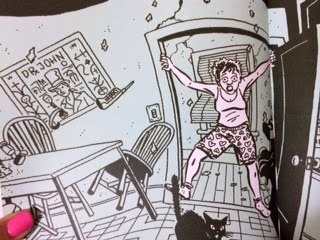
I didn’t know what to expect from a comic book that told the story of seven different people. Its pretty disturbing just knowing what happened to New Orleans after the deadliest and most destructive hurricane ever, Katrina, but I find even more disturbing the illustrations from the book. Below, are some pictures of the illustrations found in pages 67, 68, 70. The woman in them is Denise, a sixth-generation New Orleanian with a master’s degree in guidance and counseling (7) (like someone would even care about that during a hurricane).

 I


In the previous illustrations, the author, Josh Neufeld uses juxtaposition to contrast what’s happening outside of Denise’s apartment and then to her individually. I have liked Neufeld’s technique because showing a wider view of the scenario and later zooming in to different people each in their own situation, helps the audience understand what’s really going on.


I am enjoying reading comics again after all this time. However, I continue to have a doubt that I hope the book will clear not long after I finish this blog post: When someone dies, how does the author illustrate this? Especially in this case where deaths were not quite tranquil. 

lunes, 27 de enero de 2014

My Neural Trash


     As I sit here typing into my lap top, my mom yells at me from her room: “Isabela! Go to sleep now! And turn off the wi-fi!” I never really got it before. Her logic behind turning off the wi-fi so my brother could sleep well (it’s close to his room) seemed pretty stupid to me. I always told her that I preferred not to sleep for an entire week and later on be happy that I studied instead of sleeping rather than sleeping like a baby and doing bad at school.


     After reading Goodnight. Sleep Clean. by Maria Konnikova, I feel a little scared and start thinking of how my mom was right after all this time.


     Before, I thought that all the facts about the importance of sleeping were just myths. I was never one to believe that getting a “beauty sleep” really made a difference. Now, as I read Konnikova’s article I come to know about things that are much more important than just the typical “beauty sleep” and that are in fact, proven true by many researchers all over the world such as Dr. Maike Nedergaard, a Danish biologist who does research at the University of Rochester.


     By doing several tests on mice (human tests have not been made yet), researchers found out that “as your body sleeps, your brain is quite actively playing the part of mental janitor: It’s clearing out all of the junk that has accumulated as a result of your daily thinking.” I start thinking about the last week and how I never went to sleep earlier that 1 am each day. Next, I think about the scores I got on my finals and wonder if I could have gotten much better grades if I had just studied earlier and gone to sleep earlier rather than watching the Australia Open matches. Now I wonder.. Is my brain full of junk? Does this response even make sense at all or is it just my junky brain typing junky stuff?


     In her article about sleep, Konnikova mentions how “waste is cleared two times faster in a sleeping brain.”Again, I start picturing my brain full of gross things. Konnikova explains well how sleep affects the cleaning system in our brains and how “when our sleep is disturbed, whatever the cause, our cleaning system breaks down.” Also, as another researcher, Dr. Veasey puts it, “When we’re sleep-deprived, we can’t integrate or put together facts.” I always thought that suffering from sleep-deprivation would make you uglier but I never thought that a result could be “the acceleration of neurodegenerative diseases like Alzheimer’s and Parkinson’s.”


     In conclusion, Maria Konnikova’s article made me realize that sleeps brings many more drawbacks than just ugly pores and ugly circles under your eyes.  Even though there might be some aids for sleeping, “there is no evidence that aided sleep is as effective as natural sleep.” Fearful for the brain of mine being full of waste, I finish this response eager to go to bed. But of course not before I turn of the wi-fi from my brother’s room or else he will have nightmares like last week.


Vocabulary:
glial cells- a cell of the neuroglia


miércoles, 15 de enero de 2014

#Numbering the World


   I've noticed that ever since I started reading Daniel Tammet's memoir, Born on a Blue Day, I started thinking about people differently. As weird as it sounds, like Tammet, "no matter where I go or what I'm doing, numbers are never far from my thoughts." (2) At first, it seemed weird to me that someone could  think of numbers that much, but as I am getting further into the memoir, I realize that I am starting to think a little more like Tammet. I have memorized some of his tricks and I feel a little smarter. Yet, I'm very far from beating his record of memorizing and reciting more than 22,000 digits of pi. 

     What I'm liking best is the way Tammet explains how he sees numbers in different aspects of his life. He is able to visualize numbers as "smooth and round shapes, similar to pebbles on a beach." He even considers numbers "his friends who are always around him and that are each unique with their own personality." (2) I started thinking of the ways I include numbers in my daily life. Here is a list of some things I came up with:

-How many hours I get to sleep each night

-Counting the members of my family to make sure no one is missing (I also count my dog, Alan)

-How many minutes I leave in conditioner in my hair

-TV Channels

-Microwave seconds

-How many whatsapp conversations I have

-The 1800 an arepa costs

-The 45 minute lunch 

-How many likes Kendal Jenner gets on her pictures 

-The number of significant things the Kardshians do. Wait. That's zero. 

                ETC...

     My original list made me feel really stupid compared to how Damiel Tammet sees numbers in his daily life so here is a list I made while thinking more like Tammet. Using his descriptions of several numbers, I found people and situations that I find in my daily life that fit. 

Descriptions:

9- "blue, like Wednesdays, or the sound of loud voices arguing" (1)

11- "friendly" (2)

5- "loud" (2)

4- "shy and quiet, reminds him of himself" (2)

333- "beautiful" (2)

289- "ugly" (2)

89- "falling snow" (2)

37- "lumpy like a porridge" (2)


Connections:

9- The cover of Born on a Blue Day

11- Nicole Hakim

5- Luisa Reyes

4- Silvana Michelsen

333- The sun 

289- The cold mornings

89- In the news

37- The streets in Bogota